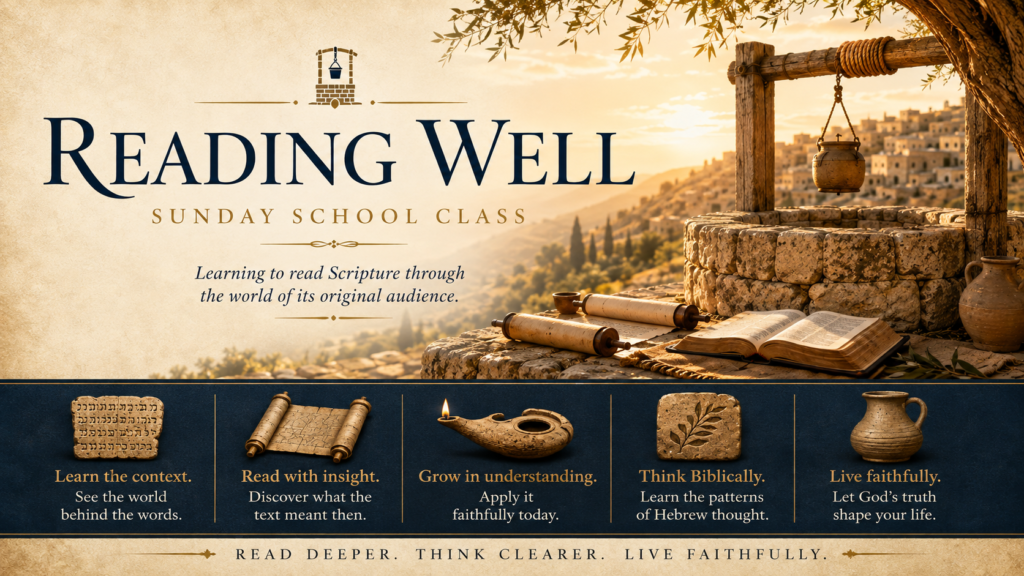
A new Sunday school class
Read the Bible
in Context
Learn to study Scripture more carefully, clearly, and confidently — a way of reading that works on any passage you open.
What 45 minutes looks like
No workbook. No reading around the circle.
- You’ll be taught, not quizzed. Most of the time is teaching, with room for questions whenever they come up.
- Talking is welcome, never required. Plenty of people come for weeks without saying a word, and that’s a fine way to be here.
- Come to one and decide. Nobody signs up for a season. Try the first Sunday and see whether it’s for you.
A taste of it
One verse, before and after.
“For our citizenship is in heaven, from where we also wait for a Savior, the Lord Jesus Christ.”
Most of us hear this as: this world isn’t our home, we’re just passing through.
Philippi was a Roman colony
Not a place Romans came from — a place Rome planted. After the battle of Actium, Augustus resettled army veterans there and granted the city Roman law, Roman self-government, and exemption from imperial tax. The people reading this letter held Roman citizenship some six hundred miles from Rome, and not one of them was packing to move there.
So Paul isn’t telling them they’re leaving. He’s telling them they’re an embassy — heaven’s own ground, standing right where they live.
And the word he chooses for citizenship shows up nowhere else in the New Testament. He uses the matching verb back in chapter one. This vocabulary appears in the one letter written to a colony.
Where this is still argued
The “passing through” reading isn’t invented. Hebrews calls its readers strangers looking for a homeland and says we have no lasting city here; 1 Peter calls them exiles. Those texts say what people think this one says.
The question is whether Philippians is saying the same thing in its own words, or something different in a city where citizenship meant staying put. Scholars land on both sides. You’re allowed to sit with that — and in this class, you can.
How this room works
A few things settled in advance.
- We discuss what the text says, not about whether someone is a real Christian.
- “I don’t know” is a legitimate place to land, and a legitimate place to stay.
- Some people prefer the quarterly, and that’s a real preference, not a failure of nerve. The other adult classes are good classes.
Straight answers
Do I need to know anything going in?
No. No Greek, no Hebrew, no background reading. Anything technical gets defined the first time it comes up.
Is this only for married couples?
No. Married, single, dating, widowed: all the same class. There’s a habit of reading with one other person, and that person can be a spouse, a friend, or someone you meet in the room.
What if I fall behind or miss a week?
You won’t be lost. Each session stands on its own well enough to walk into cold.
Is this going to be over my head?
It’s aimed at people who know their Bible well, people that have never been shown how it’s studied, and even new believers. If you can find a passage and read it, you’re the audience.
Come find out
Save a seat, or just ask a question.
Knowing roughly how many to expect helps us pick a room that fits. But you’re welcome to skip all of this and simply show up on the 13th.
Facilitated by Randy Sargent